
🧠 Neuroregression (SSPE) - Case Presentation
1. Patient Bio-Demographic Profile
- Name: Master Aditya
- Age / Sex: 9 Years / Male
- Informant: Mother & Father (Reliable)
- Address: Rural district, Uttar Pradesh (referred to tertiary center)
- Socioeconomic Status: Modified BG Prasad Class IV (Lower Socioeconomic Class)
- Handedness: Right-handed
- Date of Examination: 19th September 2024
2. Chief Complaints
- Progressive decline in school performance and memory loss since 6 months
- Sudden involuntary jerking movements and frequent falling episodes since 4 months
- Progressive stiffness of limbs and difficulty in walking since 2 months
- Slurred speech and difficulty in swallowing since 1 month
3. History of Present Illness (HPI)
"Master Aditya, a 9-year-old right-handed male child, born of a non-consanguineous marriage, with normal initial developmental milestones and excellent scholastic performance until 8.5 years of age, presented with a 6-month history of insidious-onset progressive neuroregression manifesting sequentially with cognitive and behavioral decline, stereotyped periodic myoclonic drop attacks, spastic quadriparesis, and pseudobulbar symptoms, preceded by an episode of natural measles infection at 11 months of age."
A. Chronological Elaboration of Neuroregression
1. Stage 1: Cognitive, Behavioral & Scholastic Decline (6 to 4 months ago)
- The child was previously studying in Class 4 and was among the top students in his class.
- Insidious onset of forgetfulness, inability to perform simple mental arithmetic, and deteriorating handwriting (dysgraphia).
- Parents noted subtle behavioral changes including emotional lability, unprovoked bouts of crying or laughing, social withdrawal, apathy, and difficulty following complex instructions.
- School teachers reported that he was unable to copy from the blackboard and seemed lost in the classroom.
2. Stage 2: Periodic Involuntary Spasms & Drop Attacks (4 to 2 months ago)
- Approximately 4 months ago, parents noticed sudden, brief, shock-like contractions of the neck, trunk, and upper limbs (myoclonic jerks).
- Characteristically, these spasms occur periodically every 6 to 10 seconds throughout the day.
- During these spasms, the child's head suddenly drops forward, arms abduct, and knees buckle, resulting in repeated drop attacks and falls to the ground without preceding warning or loss of consciousness.
- The frequency of jerks increases with emotional excitement and resolves during sleep.
3. Motor Deterioration & Spasticity (2 months to present)
- Progressive stiffness developed in both lower limbs, followed by upper limbs.
- Walking became clumsy, scissoring, and toe-walking in nature, eventually leading to inability to walk independently; currently requires bilateral support or remains wheelchair-bound.
- Over the last month, speech became slurred, dysarthric, and soft-spoken, with occasional coughing and choking episodes while swallowing liquids (pseudobulbar dysfunction).
B. Etiological & Negative History
Etiological & Screening Checklist:
- Natural Measles Infection: Had a severe episode of high-grade fever with typical maculopapular rash, coryza, and conjunctivitis at 11 months of age (prior to scheduled measles vaccination).
- No history of acute fever, neck stiffness, or altered consciousness at symptom onset (rules out acute viral meningoencephalitis).
- No history of head trauma, ingestion of neurotoxins, or heavy metal exposure.
- No history of recurrent episodic vomiting, ketoacidosis, or coma provoked by catabolic stress (rules out Organic Acidemias, MSUD, Urea Cycle Disorders).
- No history of night blindness, loss of vision, or hearing loss (rules out Batten disease, Refsum, Usher syndrome).
- No history of abdominal distension, jaundice, or easy bruising (rules out Wilson disease, Niemann-Pick, Gaucher).
- No family history of similar neurological illnesses, early sibling deaths, or consanguinity.
4. Past, Birth, Developmental & Dietary History
A. Past History
- Natural Measles Infection: Severe episode of high-grade fever with typical confluent maculopapular rash, coryza, and conjunctivitis at 11 months of age (unvaccinated at the time). No hospital admission was required; treated with antipyretics and home remedies.
- Other Childhood Infections: No history of mumps, rubella, varicella, tuberculosis, or recurrent seizures.
- Prior Hospitalizations / Surgeries: Nil significant. No history of intensive care unit (ICU) admission or head trauma.
B. Birth History
- Antenatal Period: Mother was a 25-year-old second gravidity mother with regular antenatal checkups at the local Primary Health Centre (PHC). Received two doses of Tetanus Toxoid (TT) and daily iron-folic acid tablets. No history of gestational diabetes, pregnancy-induced hypertension, fever with rash in first trimester, or antepartum hemorrhage. Fetal movements were perceived well.
- Natal History: Full-term home delivery conducted by a trained traditional birth attendant (Dai). Spontaneous onset of labor; baby cried immediately at birth. No history of instrumentation, prolonged rupture of membranes, or meconium-stained amniotic fluid. Approximate birth weight was $2.8\text{ kg}$.
- Postnatal History: Uneventful neonatal period. No history of neonatal jaundice, phototherapy, exchange transfusion, birth asphyxia, lethargy, poor suck, or neonatal sepsis.
C. Immunization History
- Immunization Status: Partially immunized for age as per the National Immunization Schedule (NIS).
- At Birth: BCG, OPV-0, Hepatitis B-0 given.
- At 6, 10, 14 Weeks: Pentavalent (DPT-HepB-Hib) $\times 3$, OPV $\times 3$, Rotavirus $\times 3$, fIPV $\times 2$ received.
- At 9 Months: Measles-Rubella (MR) Dose 1 was MISSED due to parental illness and local vaccine supply shortage.
- At 11 Months: Contracted natural measles infection; parents subsequently assumed natural infection conferred complete immunity and did not seek scheduled booster doses.
- Booster Doses: Did not receive 16-24 month DPT booster, OPV booster, or MR Dose 2.
D. Detailed Developmental Milestone Mapping
1. Baseline Milestone Attainment (Infancy through 8.5 Years)
Prior to the onset of the current neurological illness at 8.5 years of age, Master Aditya had achieved completely normal developmental milestones across all four classical functional domains:
Gross Motor Domain:
- Neck control achieved at 3.5 months.
- Rolled over bidirectionally at 5 months.
- Sat without support with a straight spine at 6.5 months.
- Crawled and pulled to standing at 8.5 months.
- Stood independently at 10.5 months; walked independently with good stability at 12 months.
- Ran stably, climbed stairs two feet per step at 20 months.
- Rode a tricycle independently at 3 years.
- Climbed stairs alternating feet without handrail at 4 years.
- Rode a two-wheeled bicycle without training wheels and played football actively at 6-7 years.
Fine Motor & Adaptive Domain:
- Bidextrous reaching for dangling objects at 4 months; unidextrous reaching at 5 months.
- Transferred objects hand-to-hand at 6 months.
- Mature pincer grasp (thumb and index fingertip) attained at 10 months.
- Built a tower of 3 cubes at 18 months, 6 cubes at 2 years, 9 cubes at 3 years.
- Copied a circle at 3 years, cross (+) at 4 years, square at 4.5 years, triangle at 5 years.
- Wrote neatly, buttoned and unbuttoned clothes, and tied shoelaces independently by 7 years.
Language & Communication Domain:
- Monosyllabic babbling ('ba', 'da') at 6 months; bisyllabic babbling ('dada', 'baba') at 9 months.
- First meaningful words with intent ('mama', 'papa') at 11 months.
- $10-20$ clear words at 18 months; combined two-word phrases ('want milk') at 2 years.
- Spoke in complete, grammatically correct multi-word sentences at 3 years.
- Fluent bilingual conversational skills (Hindi and local dialect), recited complex school poems, narrated sequential stories, and followed 3-step commands effortlessly at 6-7 years.
Personal-Social & Cognitive Domain:
- Social smile at 6 weeks; recognized mother at 3 months.
- Stranger anxiety at 7 months; waved 'bye-bye' and played peek-a-boo at 9 months.
- Indicated toilet needs by 2 years; achieved dry day and night continence by 3 years.
- Independent in feeding, dressing, and toilet hygiene by 5 years.
- Scholastic Excellence: Enrolled in Class 4, consistently scored $>85\%$ in examinations, was among the top 3 students in his class, demonstrated exceptional memory, and performed mental arithmetic rapidly.
2. Chronological Granular Loss of Milestones (Domain-by-Domain Regression)
Over the past 6 months, Master Aditya exhibited an insidious, unrelenting loss of previously mastered skills:
Cognitive & Scholastic Regression (Onset 6 months ago — First manifestation):
- Earliest sign was progressive decline in school performance. The child began making careless calculation errors, forgot multiplication tables, and had difficulty copying from the blackboard.
- Within 4-6 weeks, severe short-term memory loss developed (could not recall what he ate in the morning or where he placed his school bag).
- Handwriting progressively deteriorated (micrographia followed by gross dysgraphia and inability to write his name).
- Behavioral apathy, emotional lability, unprovoked bouts of crying or laughter, and social withdrawal emerged.
- Current Status: Severe dementia; disoriented to time, place, and person; unable to recognize extended family members; incapable of executing even 1-step commands reliably (estimated cognitive age $<12\text{ months}$).
Fine Motor & Adaptive Regression (Onset 4 months ago):
- Inability to write or draw (4 months ago).
- Clumsiness in handling cutlery and utensils; dropped glasses and plates due to emerging involuntary spasms (3.5 months ago).
- Loss of fine pincer manipulation, inability to button shirts, tie shoelaces, or manipulate zippers (3 months ago).
- Current Status: Gross palmar grasp only; cannot hold a spoon, pencil, or cup; entirely dependent on mother for feeding and dressing (estimated fine motor age $\approx 6\text{ months}$).
Gross Motor Regression (Onset 3 months ago):
- Clumsy, uncoordinated gait and frequent tripping (3 months ago).
- Sudden unheralded drop attacks and falls due to periodic myoclonic spasms causing knee buckling (2.5 months ago).
- Development of progressive lower limb spasticity, scissoring, and toe-walking (2 months ago).
- Inability to run or climb stairs (2 months ago); lost unassisted walking ability (6 weeks ago).
- Lost ability to stand unassisted (4 weeks ago).
- Current Status: Bedbound to wheelchair-bound; sits only with pelvic and trunk support; marked head lag when pulled to sit (estimated gross motor age $\approx 6\text{ months}$).
Language & Bulbar Regression (Onset 2 months ago):
- Speech became progressively slow, dysarthric, and slurred (2 months ago).
- Loss of complex grammatical sentences; regression to 2-3 word fragmented phrases (6 weeks ago).
- Rapid decline into monosyllabic, hypophonic utterances and unintelligible vocalizations (3 weeks ago).
- Emergence of pseudobulbar dysphagia with coughing, nasal regurgitation, and choking episodes on liquids (3 weeks ago).
- Current Status: Non-communicative; emits occasional guttural grunts; marked oral-pharyngeal dysphagia requiring thick pureed feeds (estimated language age $\approx 9-10\text{ months}$).
3. Chronological Regression Matrix
| Developmental Domain | Peak Attained Milestone & Age | Onset of Decline | Sequential Milestones Lost | Current Functional Level | Estimated DA |
|---|---|---|---|---|---|
| Cognitive / Social | Class topper (Class 4), arithmetic, independent ADLs ($8\text{y}$) | 6 months ago | Mental arithmetic $\rightarrow$ handwriting $\rightarrow$ short-term memory $\rightarrow$ orientation $\rightarrow$ ADLs | Profound dementia, disoriented, apathy, full dependence | $\approx 12\text{ months}$ |
| Fine Motor | Wrote neatly, tied shoelaces, cut with scissors ($7.5\text{y}$) | 4 months ago | Writing $\rightarrow$ tying laces $\rightarrow$ buttoning $\rightarrow$ utensil handling $\rightarrow$ pincer grasp | Gross palmar grasp only; unable to hold spoon or cup | $\approx 6\text{ months}$ |
| Gross Motor | Rode 2-wheel bicycle, ran fast, played football ($7.5\text{y}$) | 3 months ago | Bicycle riding $\rightarrow$ running $\rightarrow$ stairs $\rightarrow$ independent walking $\rightarrow$ standing | Non-ambulatory; sits with trunk support; head lag present | $\approx 6\text{ months}$ |
| Language / Speech | Fluent bilingual sentences, told complex stories ($8\text{y}$) | 2 months ago | Complex narrative $\rightarrow$ sentence structure $\rightarrow$ naming $\rightarrow$ clear articulation | Monosyllabic, dysarthric vocalizations, guttural grunts | $\approx 10\text{ months}$ |
4. Developmental Quotient (DQ) Calculations
The Developmental Quotient (DQ) expresses functional maturity as a percentage of chronological age:
$$\text{Developmental Quotient (DQ)} = \frac{\text{Developmental Age (DA)}}{\text{Chronological Age (CA)}} \times 100$$- Pre-morbid Chronological Age (at baseline 8.5 years): $\text{CA} = 102\text{ months}$, $\text{DA} = 102\text{ months} \implies \mathbf{\text{Baseline DQ} = 100\%}$ across all domains.
- Current Chronological Age: $9\text{ years} = 108\text{ months}$.
Domain-Specific Current Developmental Quotients:
Gross Motor Domain:
$$\text{DQ}_{\text{GM}} = \frac{6\text{ months}}{108\text{ months}} \times 100 = 5.56\% \quad (\text{Severe Gross Motor Regression})$$Fine Motor & Adaptive Domain:
$$\text{DQ}_{\text{FM}} = \frac{6\text{ months}}{108\text{ months}} \times 100 = 5.56\% \quad (\text{Severe Fine Motor Regression})$$Language & Communication Domain:
$$\text{DQ}_{\text{Lang}} = \frac{10\text{ months}}{108\text{ months}} \times 100 = 9.26\% \quad (\text{Profound Expressive & Receptive Aphasia/Regression})$$Personal-Social & Cognitive Domain:
$$\text{DQ}_{\text{Social}} = \frac{12\text{ months}}{108\text{ months}} \times 100 = 11.11\% \quad (\text{Profound Neurocognitive Deterioration / Dementia})$$
Composite Global Developmental Quotient:
$$\text{Mean Developmental Age (DA)} = \frac{6 + 6 + 10 + 12}{4} = 8.5\text{ months}$$$$\mathbf{\text{Overall Global DQ}} = \frac{8.5\text{ months}}{108\text{ months}} \times 100 = \mathbf{7.87\%}$$This clinical trajectory represents true progressive neuroregression with an unequivocal loss of previously attained, age-appropriate milestones.
- Key Diagnostic Clue: Cognitive, scholastic, and behavioral decline preceded motor and speech deterioration by $2-3\text{ months}$, pointing anatomically to cerebral cortex / grey matter onset, followed rapidly by white matter tract involvement (spasticity, hyperreflexia), classic of Subacute Sclerosing Panencephalitis (SSPE).
5. Pediatric Semiotics: Differential Spectrum of Developmental Delay
| Clinical Entity | Milestone Acquisition Pattern | Clinical Course | Example Etiology | Status in Master Aditya |
|---|---|---|---|---|
| Static Developmental Delay | Milestones acquired at an abnormally slow pace from birth, but skills are never lost | Static / Non-progressive neurological deficit | Cerebral Palsy secondary to HIE | Excluded (Milestones were completely normal up to $8.5\text{y}$) |
| Developmental Arrest (Plateauing) | Normal or delayed acquisition followed by cessation of further milestone progress, with NO active loss of skills | Cessation of progress without active regression | Severe Nutritional Deficiency, Craniopharyngioma, Hypothyroidism | Excluded (Active, catastrophic loss of previously attained skills) |
| True Progressive Neuroregression | Attainment of normal (or near-normal) milestones followed by active, progressive loss of previously mastered skills | Subacute or chronic neurodegenerative deterioration | SSPE, Neuronal Ceroid Lipofuscinosis, Leukodystrophies, Wilson Disease | CONFIRMED (Loss of speech, ambulation, cognition, and continence over 6 months) |
E. Dietary History & 24-Hour Recall
| Meal Time | Food Item & Composition | Quantity | Energy (kcal) | Protein (g) |
|---|---|---|---|---|
| Breakfast | Dalia (Wheat porridge) with buffalo milk + sugar | 1 katori (150 g) | 180 | 5.2 |
| Lunch | Boiled rice with watery arhar dal | 1.5 katori (180 g) + 1 katori (100 g) | 210 + 80 | 4.0 + 4.5 |
| Evening Snack | Tea with 2 rusk biscuits | 100 ml + 2 rusks | 110 | 2.0 |
| Dinner | Roti (2 small) + Aloo-tamatar sabzi | 60 g + 100 g | 160 + 65 | 4.5 + 1.2 |
| Total Intake | 805 kcal | 21.4 g | ||
| RDA (ICMR-NIN 2024 for 9y/M) | 1700 kcal | 29.5 g | ||
| Deficit / Excess | -895 kcal (-52.6%) | -8.1 g (-27.5%) |
Significant nutritional compromise due to emerging dysphagia, slow chewing, and motor disability requiring immediate nutritional rehabilitation (nasogastric tube / calorie-dense pureed feeds).
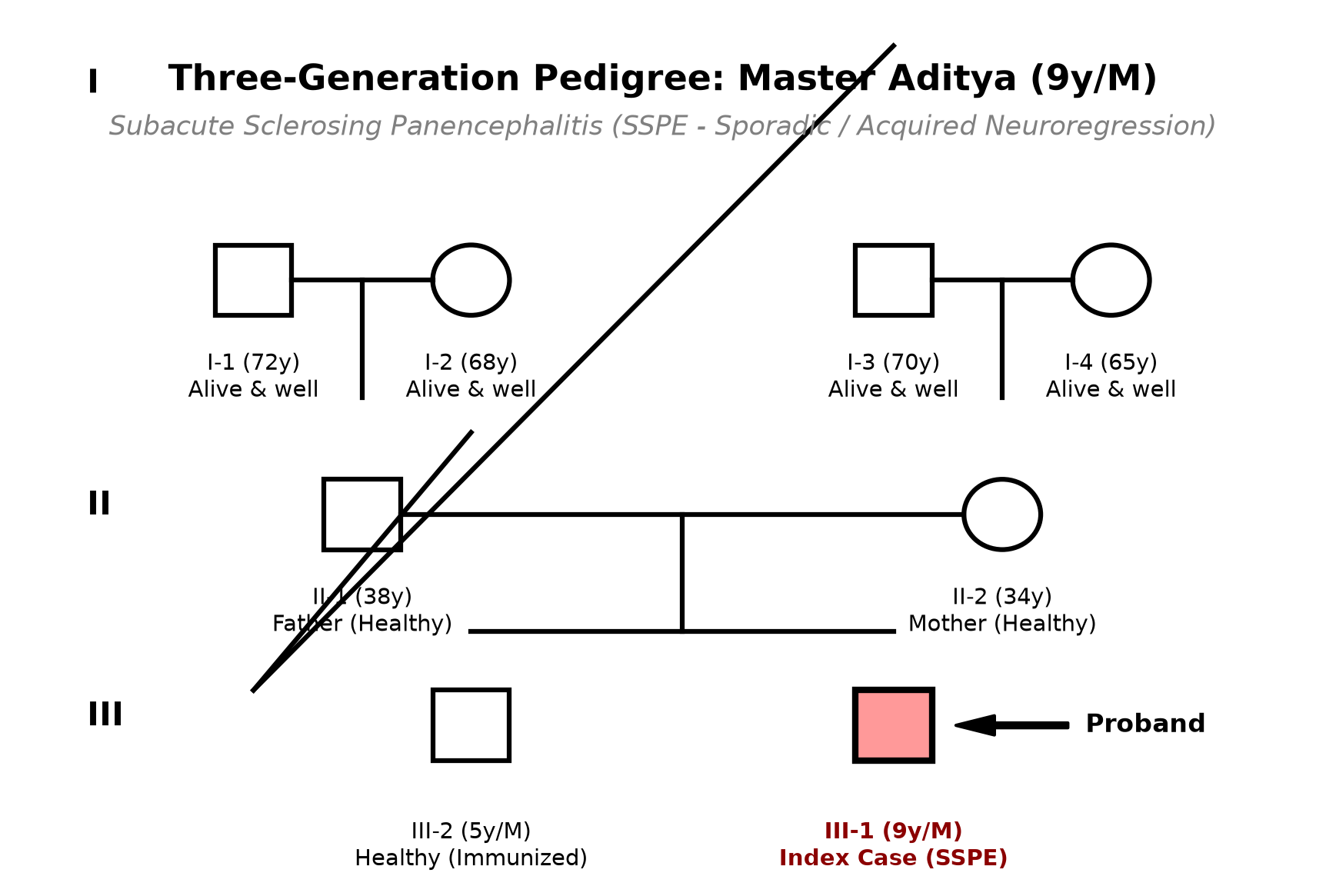
5. Family History & Pedigree
- Parents are non-consanguineous.
- Father (38y) is a daily-wage laborer; Mother (34y) is a homemaker.
- Younger brother (5y) is healthy, thriving, and fully vaccinated with two doses of MR vaccine.
6. General Physical Examination
- Child Behavioral State: Awake, apathetic, intermittently smiling inappropriately, easily startled by tactile stimuli.
- Vitals:
- Heart Rate: 88 beats/min (regular, good volume)
- Respiratory Rate: 20 breaths/min (regular)
- Blood Pressure: $102/66\text{ mmHg}$ ($50^{\text{th}}$ centile)
- Temperature: $98.6^\circ\text{F}$ (Afebrile)
- Capillary Refill Time (CRT): $<2$ seconds
- General Markers: Mild pallor present; no icterus, cyanosis, clubbing, lymphadenopathy, or pedal edema.
- Neurocutaneous / Dysmorphic Markers: Absent. No café-au-lait spots, no telangiectasia, no coarse features.
- Skeletal: Spine normal; no contractures currently, but tight Achilles tendons bilaterally.
Anthropometry
| Metric | Patient Value | Expected (50th Centile WHO) | Z-Score | Nutritional Status |
|---|---|---|---|---|
| Weight | 21.0 kg | 28.1 kg | -2.1 SD | Moderate Malnutrition |
| Height | 126.0 cm | 133.3 cm | -1.2 SD | Mild Stunting |
| BMI | 13.2 kg/m² | 15.8 kg/m² | -2.2 SD | Moderate Thinness (WHO) |
| Head Circumference | 51.5 cm | 51.8 cm | -0.2 SD | Normocephalic (No macro/microcephaly) |
7. Central Nervous System (CNS) Examination
A. Higher Mental Functions (HMF)
General Appearance & Demeanor:
- The child is awake, sitting slumped in a wheelchair with bilateral head and trunk support.
- Marked facial hypomimia (masked facies) with an unblinking, vacant stare and infrequent spontaneous smiling.
- Marked emotional lability observed: unprovoked bursts of inappropriate giggling alternating with irritable whimpering without apparent external provocation.
- Extremely irritable during passive handling; hyperreactive to environmental auditory stimuli (loud sounds trigger immediate myoclonic spasms).
Consciousness & Sensorium:
- Conscious but profoundly detached; lack of meaningful visual engagement or eye contact.
- Glasgow Coma Scale (Modified Pediatric): Eye Opening = 4 (Spontaneous), Best Verbal Response = 2 (Incomprehensible guttural sounds), Best Motor Response = 5 (Localizes / withdraws purposefully to painful stimuli). Total GCS = 11/15.
Orientation, Attention & Concentration:
- Completely disoriented to time (unable to distinguish day from night), place (unaware of hospital surroundings), and person (does not identify parents by name, though occasionally calms to mother's voice).
- Attention span is severely abbreviated ($<5\text{ seconds}$); inability to sustain focus on a colorful visual target; unable to perform digit span testing forward or backward.
Memory Assessment:
- Immediate Recall: Unable to register or repeat 3 simple objects (ball, car, cup).
- Recent Memory: Inability to recall breakfast or identify the doctor who examined him 15 minutes prior.
- Remote Memory: Unable to name his school, teacher, village, or age.
Speech & Language Evaluation:
- Spontaneous Speech: Severely impoverished; restricted to monosyllabic, dysarthric vocalizations ('aa', 'ba') and low-pitched groans.
- Comprehension: Severely compromised. Inability to execute simple 1-step verbal commands (e.g., 'open your mouth', 'give me your hand'); responds only to direct physical touch or tactile guiding.
- Repetition: Completely absent; unable to repeat single words.
- Naming: Anomia present; cannot name common objects shown (pen, spoon, watch).
- Articulation: Marked spastic-pseudobulbar dysarthria; vocalizations are strained, strangled, and hypophonic.
- Reading & Writing: Profound alexia and agraphia (unable to identify letters or hold a pen).
Praxis & Cortical Sensations:
- Severe ideomotor and dressing apraxia; unable to imitate gestures (saluting, blowing a kiss) or coordinate limb movement to put on a cap.
- Astereognosis and visual agnosia clinically evident (cannot identify familiar feeding spoon by sight or touch).
Frontal Release Signs (Primitive Reflexes of Frontal Lobe Disinhibition):
- Bilateral cortical disinhibition resulting from diffuse cerebral cortical damage:
| Frontal Release Sign | Elicitation Technique | Patient Response | Clinical & Anatomical Inference |
|---|---|---|---|
| Palmar Grasp Reflex | Stroke the patient's palm from ulnar to radial side | Strongly Positive Bilaterally (Involuntary sustained gripping) | Bilateral premotor frontal cortex (Brodmann Area 6) lesion |
| Palmomental Reflex | Rapidly scratch the thenar eminence with a blunt pin | Positive Bilaterally (Ipsilateral mentalis muscle twitch) | Corticobulbar / Paracentral frontal disinhibition |
| Snout / Pout Reflex | Gently tap the closed upper lip in the midline | Markedly Positive (Vigorous puckering/protrusion of lips) | Bilateral supranuclear corticobulbar tract degeneration |
| Suck Reflex | Stroke the lips with a gloved finger | Positive (Involuntary sucking movements elicited) | Primitive frontal release sign; diffuse bi-hemispheric loss |
| Glabellar Tap (Myerson's Sign) | Repetitively tap the glabella from behind visual field | Positive (Persistent uninhibited blinking $>5$ taps) | Failure of cortical habituation / Frontal lobe damage |
B. Involuntary Movements: Hallmark Periodic Myoclonus (Radermecker Jerks)
The most striking clinical abnormality is the presence of stereotyped, involuntary, periodic spasms characteristic of Jabbour Stage 2 SSPE:
| Movement Parameter | Clinical Characteristic Observed | Diagnostic Significance |
|---|---|---|
| Type of Involuntary Movement | Stereotyped Periodic Myoclonus (Radermecker Jerks) | Cardinal motor hallmark of Subacute Sclerosing Panencephalitis |
| Anatomical Distribution | Synchronous, generalized involvement of head, axial musculature, and all four limbs | Cortico-subcortical and thalamic pacemaker generation |
| Semiology & Biomechanics | Biphasic Movement: 1. Phase 1 (Active contraction): Sudden, abrupt flexion of neck, elevation and abduction of shoulders, flexion of elbows, and flexion at hips and knees. 2. Phase 2 (Slow relaxation): Pathognomonic slow, gradual, melting relaxation phase lasting $1-2\text{ seconds}$. | The slow relaxation phase distinguishes SSPE myoclonus from cortical myoclonus (which has instantaneous, brisk relaxation) |
| Periodicity & Interval | Recurs rhythmically every 6 to 8 seconds (measured by stopwatch over 10 consecutive cycles: intervals ranged between $6.2\text{ s}$ and $7.8\text{ s}$) | Perfect interval stereotyping reflecting subcortical rhythmic pacemaker |
| Consciousness During Jerks | Consciousness is completely preserved during and immediately following the jerk; no post-ictal confusion | Rules out generalized clonic seizures |
| Postural Consequences | In sitting or supported standing position, each spasm causes sudden loss of axial tone following contraction, leading to violent drop attacks (astasia-abasia) | Major source of repeated unprovoked head and facial trauma |
| Modulating Factors | Exaggerated by: Sudden loud auditory stimuli (clapping hands), bright light flash, or unexpected tactile touch. Ceases completely: During slow-wave and REM sleep. | Pathognomonic stimulus-sensitive reflex myoclonus; disappearance in sleep confirms subcortical generation |
| Associated Involuntary Movements | Absent: No chorea, no athetosis, no hemiballismus, no dystonic posturing at rest, and no resting pin-rolling tremors. | Rules out Huntington chorea, Sydenham chorea, and Wilson disease dystonia |
C. Detailed Cranial Nerve Examination Battery
CN I (Olfactory Nerve):
- Not formally testable due to cognitive impairment, receptive aphasia, and inability to verbalize scent recognition.
CN II (Optic Nerve):
- Visual Acuity: Fixates irregularly and inconsistently tracks bright red/colorful objects across the horizontal midline; blinks reliably to visual threat in both eyes.
- Visual Fields: Confrontation testing shows menace reflex / blink-to-threat present in all four visual quadrants; no gross homonymous hemianopia detectable.
- Pupillary Reflexes:
- Pupils are round, regular, symmetrical, measuring $3.5\text{ mm}$ in ambient light.
- Direct light reflex is brisk and sustained bilaterally ($2+/2+$).
- Consensual light reflex is brisk bilaterally ($2+/2+$).
- Relative Afferent Pupillary Defect (RAPD / Marcus Gunn pupil): Absent on swinging flashlight test.
- Fundoscopy (Dilated Direct and Indirect Ophthalmoscopy):
- Optic Disc: Well-defined, sharp margins bilaterally; normal physiological cup-to-disc ratio ($0.3$); disc color is healthy pink without pallor (no primary or secondary optic atrophy at this stage); no papilledema, venous engorgement, or disc hemorrhages.
- Retinal Vasculature: Normal caliber and arteriovenous ratio ($2:3$); no arteriolar attenuation, perivascular sheathing, or copper/silver wiring.
- Macula & Fovea: Normal foveal reflex bilaterally.
- Pertinent Fundoscopic Negatives:
- NO Cherry-Red Spot (rules out GM1/GM2 Gangliosidosis, Niemann-Pick Type A, Sialidosis).
- NO Bull's Eye Maculopathy or Retinal Pigmentary Degeneration / Bone-Spicule Pigmentation (rules out Neuronal Ceroid Lipofuscinosis / Batten Disease, Refsum disease, Kearns-Sayre syndrome).
- NO Chorioretinitis Scars or Active Necrotizing Retinitis (Note: SSPE can present with macular chorioretinitis in $10-50\%$ of cases; currently clear in Aditya).
CN III, IV, VI (Oculomotor, Trochlear, Abducens Nerves):
- Ocular Alignment: Eyes are aligned in primary position; no strabismus, esotropia, or exotropia.
- Extraocular Movements: Full horizontal and vertical range of ocular excursions on vestibulo-ocular (doll's eye) testing.
- Pursuit & Saccades: Smooth pursuit movements are jerky (saccadic pursuit); voluntary saccades are slow and hypometric.
- Nystagmus: Absent in primary position and on horizontal/vertical eccentric gaze.
- Ptosis: Absent bilaterally; palpebral fissures are equal ($9\text{ mm}$).
- Vertical Supranuclear Gaze Palsy (VSGP): Absent. Full conjugate vertical upgaze and downgaze elicited on doll's eye maneuver (rules out Niemann-Pick Type C and Progressive Supranuclear Palsy).
CN V (Trigeminal Nerve):
- Motor Division: Temporalis and masseter muscles demonstrate normal bulk without atrophy. On clenching during crying, masseter contraction is palpable bilaterally. Jaw does not deviate on mouth opening.
- Sensory Division: Intact facial sensation demonstrated by prompt, symmetrical grimacing and withdrawal to light pinprick across all three divisions ($V_1, V_2, V_3$) bilaterally.
- Corneal Reflex: Brisk bilateral direct and consensual blink responses elicited on touching the cornea with a wisp of sterile cotton.
- Jaw Jerk (Masseter Reflex): Pathologically Brisk / Hyperreflexic ($3+$). Tapping the chin with the mouth slightly open elicits a sudden, exaggerated mandibular elevation.
- Clinical Significance: Confirms a bilateral upper motor neuron (corticobulbar) tract lesion above the mid-pons.
CN VII (Facial Nerve):
- Motor Function: Symmetrical nasolabial folds at rest. Mild bilateral facial hypomimia with decreased spontaneous blink rate ($4-6\text{ blinks/min}$, normal $12-16$).
- Emotional vs Voluntary Movement: When crying or grimacing to noxious stimulus, facial movements are symmetrical; forehead wrinkles bilaterally, eyes close tightly, and angle of mouth retracts equally on both sides.
- Inference: No Lower Motor Neuron or focal Upper Motor Neuron facial palsy.
CN VIII (Vestibulocochlear Nerve):
- Responds to sound: Turns head towards mother's voice and startles to a loud clap; blinks reliably to sudden auditory stimuli (auropalpebral reflex present).
- No clinical evidence of sensorineural deafness.
CN IX, X (Glossopharyngeal and Vagus Nerves):
- Palatal Elevation: Soft palate hangs low bilaterally; elevation during vocalization is sluggish but symmetrical. Uvula is central in the midline.
- Phonation: Voice is low-pitched, harsh, strained, and hypophonic.
- Deglutition & Secretions: Pooling of saliva in the posterior oropharynx with intermittent drooling; recurrent coughing and choking paroxysms during liquid ingestion.
- Gag Reflex (Pharyngeal Reflex): Markedly Exaggerated / Hyperactive ($4+$). Touching the posterior pharyngeal wall with a tongue depressor elicits an immediate, vigorous, spastic retching response.
- Clinical Diagnosis: Pseudobulbar Palsy (see comparative table below).
CN XI (Spinal Accessory Nerve):
- Sternocleidomastoid and trapezius muscles demonstrate preserved bulk without focal atrophy.
- Hypertonia palpable in neck muscles; active head turning is sluggish, but resisted neck movements elicit bilateral sternocleidomastoid contraction.
CN XII (Hypoglossal Nerve):
- Inspection in Oral Cavity: Tongue lies in the floor of the mouth with normal bulk. NO fasciculations, fibrillations, or furrowed wasting observed.
- Protrusion: Protrudes in the midline without deviation.
- Tone & Movement: Tongue appears spastic, stiff, and contracted; lateral alternating tongue movements are slow and clumsy.
Clinical Distinction: True Bulbar Palsy vs Pseudobulbar Palsy in Aditya
| Diagnostic Feature | True Bulbar Palsy (LMN) | Pseudobulbar Palsy (UMN) | Finding in Master Aditya |
|---|---|---|---|
| Lesion Localization | Motor nuclei of CN IX, X, XII in medulla | Bilateral corticobulbar tracts (supranuclear) | Bilateral Corticobulbar Tracts |
| Gag Reflex | Absent or markedly diminished | Exaggerated / Hyperactive | Markedly Exaggerated ($4+$) |
| Jaw Jerk | Normal or absent | Pathologically Brisk ($3+$) | Hyperactive ($3+$) |
| Tongue Appearance | Flaccid, wasted, furrowed, with fasciculations | Spastic, small, stiff, NO fasciculations | Spastic, stiff, NO fasciculations |
| Emotional Lability | Absent | Present (Pathological crying/laughter) | Prominent unprovoked crying/laughter |
| Dysphagia & Dysarthria | Flaccid / Nasal twang | Spastic, strained, strangled voice | Spastic, strained, choked voice |
| Associated Signs | Neck weakness, LMN signs | Spastic quadriparesis, brisk DTRs, Babinski $+$ | Bilateral Babinski $+$, sustained clonus |
D. Motor System Examination
1. Inspection & Attitude of Limbs
- Attitude in Bed: Child lies with head slightly retracted; upper limbs are held in adduction at shoulders, flexion at elbows, pronation of forearms, and slight flexion of wrists with fisting of hands. Lower limbs demonstrate adduction at hips (tendency to scissoring), extension at knees, and bilateral plantar flexion with inversion at ankles (equinovarus posture).
- Abnormal Involuntary Movements: Stereotyped periodic myoclonic spasms occurring every $6-8\text{ seconds}$ as detailed in Section 7B.
- Muscle Wasting & Fasciculations: No focal or asymmetric muscle wasting; no visible muscle fasciculations or fibrillations under tangential lighting.
2. Muscle Bulk & Trophicity
Symmetric mild generalized muscle wasting consistent with disuse atrophy and secondary moderate malnutrition:
| Anatomical Segment | Measurement Landmark | Right Limb | Left Limb | Symmetry & Interpretation |
|---|---|---|---|---|
| Mid-Arm Circumference | $10\text{ cm}$ proximal to lateral epicondyle | $14.2\text{ cm}$ | $14.2\text{ cm}$ | Symmetric; mild disuse wasting |
| Forearm Circumference | $5\text{ cm}$ distal to lateral epicondyle | $12.8\text{ cm}$ | $12.7\text{ cm}$ | Symmetric |
| Mid-Thigh Circumference | $12\text{ cm}$ proximal to superior patellar pole | $28.5\text{ cm}$ | $28.4\text{ cm}$ | Symmetric; mild quadriceps wasting |
| Maximum Calf Circumference | Point of maximum calf girth | $19.0\text{ cm}$ | $19.1\text{ cm}$ | Symmetric; tight gastroc-soleus |
3. Muscle Tone (Evaluation of Spasticity)
Examination reveals generalized, bilateral, severe velocity-dependent hypertonia (Clasp-Knife Spasticity) predominantly affecting the antigravity muscles (upper limb flexors and lower limb extensors):
| Joint / Muscle Group Tested | Movement Evaluated | Modified Ashworth Scale (MAS) | Clinical Characteristics Elicited |
|---|---|---|---|
| Shoulder Adductors / Internal Rotators | Passive abduction | Grade 2 | Marked resistance through second half of ROM |
| Elbow Flexors (Biceps / Brachialis) | Passive extension | Grade 2 | Initial catch followed by clasp-knife release |
| Forearm Pronators | Passive supination | Grade 2 | Resistance prominent through full range |
| Wrist & Finger Flexors | Passive wrist/finger extension | Grade 2 | Cortical fisting; passive opening elicits resistance |
| Hip Adductors | Passive hip abduction | Grade 3 | Considerable resistance; severe scissoring posture |
| Hip Extensors / Hamstrings | Popliteal angle measurement | Grade 3 | Popliteal angle restricted to $130^\circ$ bilaterally |
| Knee Extensors (Quadriceps) | Passive knee flexion | Grade 3 | High velocity-dependent catch; passive flexion difficult |
| Ankle Plantarflexors (Gastroc-Soleus) | Rapid passive dorsiflexion | Grade 3 | Marked resistance; tight Achilles tendon; clonus triggered |
- In Aditya (Stage 2 SSPE): Tone is velocity-dependent clasp-knife spasticity (greater resistance at rapid stretch followed by sudden release) with predilection for upper limb flexors and lower limb extensors, indicating pure pyramidal (corticospinal) tract involvement.
- In Stage 3 SSPE: Tone evolves into extrapyramidal lead-pipe / cogwheel rigidity (equal resistance throughout range in both flexors and extensors, velocity-independent) signaling subcortical and basal ganglia degeneration.
4. Muscle Power Assessment (MRC Scale)
Voluntary power assessment is partially constrained by cognitive dementia, apraxia, and periodic myoclonus; evaluated through active spontaneous movements, anti-gravity positioning, and withdrawal against resistance:
| Anatomical Joint | Muscle Group Evaluated | Right Side | Left Side | Functional Performance |
|---|---|---|---|---|
| Shoulder | Abductors / Adductors | Grade 4/5 | Grade 4/5 | Can lift arms against gravity; yields to moderate force |
| Elbow | Flexors / Extensors | Grade 4/5 | Grade 4/5 | Active flexion/extension present; reduced terminal power |
| Wrist & Fingers | Extensors / Hand Grip | Grade 3+/5 | Grade 3+/5 | Weak grasp; unable to maintain sustained hand grip |
| Hip | Flexors / Extensors / Abductors | Grade 3/5 | Grade 3/5 | Can move limbs against gravity; yields to minimal resistance |
| Knee | Flexors / Extensors | Grade 3+/5 | Grade 3+/5 | Extends knee against gravity; unable to overcome resistance |
| Ankle & Toes | Dorsiflexors / Plantarflexors | Grade 3/5 | Grade 3/5 | Weak active dorsiflexion; overpowered by calf spasticity |
| Overall Motor Pattern | Symmetrical Spastic Quadriparesis (LL > UL) |
5. Deep Tendon Reflexes (DTRs) & Clonus Battery
Reflexes were examined in a warm, relaxed environment with appropriate positioning:
| Deep Tendon Reflex | Nerve Root Level | Right Limb | Left Limb | Clinical Observations |
|---|---|---|---|---|
| Biceps Jerk | $C_5, C_6$ (Musculocutaneous) | $3+$ (Brisk) | $3+$ (Brisk) | Exaggerated jerk with extension of reflexogenic zone |
| Triceps Jerk | $C_7, C_8$ (Radial) | $3+$ (Brisk) | $3+$ (Brisk) | Brisk contraction of triceps muscle |
| Supinator (Brachioradialis) | $C_5, C_6$ (Radial) | $3+$ (Brisk) | $3+$ (Brisk) | Brisk wrist flexion; NO inverted radial reflex |
| Finger Flexor Jerk | $C_8, T_1$ (Median/Ulnar) | Positive ($3+$) | Positive ($3+$) | Hoffmann's sign and Trömner sign positive bilaterally |
| Knee Jerk (Patellar Reflex) | $L_3, L_4$ (Femoral) | $4+$ (Hyperactive) | $4+$ (Hyperactive) | Clonus-like repetitive contractions; Crossed Adductor Reflex Positive |
| Ankle Jerk (Achilles Reflex) | $S_1, S_2$ (Tibial) | $4+$ (Hyperactive) | $4+$ (Hyperactive) | Elicited with light tap; triggers sustained ankle clonus |
| Patellar Clonus | $L_3, L_4$ | Present ($4-6\text{ beats}$) | Present ($4-6\text{ beats}$) | Elicited on sharp downward displacement of patella |
| Ankle Clonus | $S_1$ | Sustained ($>10\text{ beats}$) | Sustained ($>10\text{ beats}$) | Persistent, rhythmic oscillations without fatigue |
6. Superficial Reflexes
- Abdominal Reflexes:
- Upper Abdominal ($T_7, T_8, T_9$): Absent bilaterally.
- Middle Abdominal ($T_9, T_{10}, T_{11}$): Absent bilaterally.
- Lower Abdominal ($T_{11}, T_{12}$): Absent bilaterally.
- Inference: Universal loss of superficial abdominal reflexes strongly corroborates bilateral corticospinal (pyramidal) tract pathology.
- Cremasteric Reflex ($L_1, L_2$): Sluggish to absent bilaterally.
- Plantar Response ($S_1, S_2$):
- Bilateral Extensor Response (Babinski Sign Strongly Positive):
- Stroking the lateral aspect of the sole elicits slow, tonic extension (dorsiflexion) of the great toe accompanied by fanning (abduction) of the other four toes and flexion at knee and hip.
- Confirmatory Pyramidal Reflex Maneuvers:
- Chaddock Sign: Stroking lateral malleolus $\rightarrow$ Extensor toe response positive bilaterally.
- Oppenheim Sign: Heavy downward friction over anterior tibial crest $\rightarrow$ Extensor response positive bilaterally.
- Gordon Sign: Squeezing calf muscle belly $\rightarrow$ Extensor response positive bilaterally.
- Bilateral Extensor Response (Babinski Sign Strongly Positive):
E. Sensory System Examination
- Superficial Sensation (Pain & Touch):
- Light touch tested with sterile cotton wisp and pain tested with single-use neurological pin.
- The child reliably grimaces and withdraws limbs symmetrically to pinprick stimulation across all dermatomal segments from $C_2$ to $S_1$.
- No sensory dissociation observed; no focal sensory level on the trunk.
- Deep & Cortical Sensation:
- Joint position sense, vibration sense (tested with $128\text{ Hz}$ tuning fork over bony prominences), and two-point discrimination cannot be formally confirmed due to profound expressive aphasia and cognitive dementia.
- No clinical evidence of sensory ataxia (pseudoathetosis absent; withdrawal to proprioceptive passive movement is preserved).
F. Cerebellar System & Coordination
- Voluntary Coordination:
- Formal finger-nose and heel-knee-shin tests cannot be performed accurately due to motor apraxia and frequent myoclonic interruptions.
- During reaching attempts for objects, prominent terminal kinetic tremors and intention dysmetria are observed bilaterally.
- Rapid alternating movements (dysdiadochokinesia) are clumsy and disorganized bilaterally.
- Axial Stability, Stance & Gait:
- Sitting Balance: Impaired; unstable without lateral pelvic and back support.
- Standing & Walking: Inability to stand unassisted. When supported by two examiners, the child exhibits a severe spastic-ataxic gait characterized by stiff leg swing, narrow base with thigh scissoring, bilateral toe-walking, and episodic catastrophic collapses caused by periodic myoclonic drop attacks.
- Romberg Test: Cannot be evaluated (patient cannot stand independently with eyes open).
G. Autonomic Function, Cranium & Meningeal Signs
- Autonomic Nervous System:
- Bladder and Bowel Function: Emerging urinary and fecal incontinence; history of uninhibited neurogenic bladder emptying secondary to loss of higher cortical inhibition over the pontine micturition center.
- Vasomotor & Secretomotor: Peripheral extremities are warm with normal capillary refill time ($<2\text{ seconds}$); no asymmetrical hyperhidrosis or Horner syndrome. Blood pressure demonstrates no orthostatic fluctuation.
- Cranium & Spine Examination:
- Head circumference measures $51.5\text{ cm}$ ($-0.2\text{ SD}$, normocephalic).
- Cranial sutures and anterior fontanelle completely closed.
- Auscultation over globes, temples, and mastoid processes reveals no cranial bruits.
- Spine is straight with normal cervical and lumbar lordosis; no scoliosis, kyphosis, spina bifida occulta, tuft of hair, or sinus tract.
- Meningeal Signs:
- Neck Rigidity: Absent (neck is supple on passive flexion, excluding acute meningitis).
- Kernig Sign: Absent bilaterally.
- Brudzinski Neck and Symphyseal Signs: Absent.
8. Other Systemic Examination
- Cardiovascular System: S1, S2 heard normally, no murmurs.
- Respiratory System: Clear breath sounds; no aspiration crackles.
- Abdomen: Soft, non-tender, no hepatosplenomegaly (Liver span 8 cm, Spleen not palpable).
9. Comprehensive Localization & Staging
A. Anatomical & Pathophysiological Localization
- Panencephalitic Involvement:
- Cerebral Cortex (Grey Matter): Early dementia, scholastic decline, behavioral changes, frontal release signs.
- Subcortical / White Matter Tracts: Bilateral corticospinal tract involvement manifesting as spastic quadriparesis, hyperreflexia, ankle clonus, and extensor plantars.
- Cortico-Subcortical / Thalamic Pacemaker: Generation of stereotyped, periodic, synchronous myoclonic spasms recurring every 6–8 seconds.
B. Jabbour Clinical Staging for SSPE
| Jabbour Stage | Clinical Features | Status in Patient |
|---|---|---|
| Stage 1 (Behavioral / Cognitive) | Subtle intellectual decline, emotional lability, lethargy, drop in school grades | Passed (6 to 4 months ago) |
| Stage 2 (Myoclonus / Motor) | Periodic myoclonus, drop attacks, spasticity, dysarthria, apraxia, visual changes | CURRENT STAGE (Stage 2) |
| Stage 3 (Extrapyramidal / Rigidity) | Decerebrate / decorticate posturing, severe rigidity, stupor, dysphagia, coma | Not yet reached |
| Stage 4 (Autonomic / Vegetative) | Akinetic mutism, flexion contractures, loss of cortical function, autonomic failure | End-stage |
C. Differential Diagnosis Matrix
| Differential Diagnosis | Points in Favor | Points Against / Differentiating Features |
|---|---|---|
| Subacute Sclerosing Panencephalitis (SSPE) | • 9y boy with natural measles at 11m • Subacute neuroregression • Stereotyped periodic myoclonus every 6-8s • Spastic quadriparesis + dementia | Definitive Diagnosis (Meets Dyken's Criteria) |
| Neuronal Ceroid Lipofuscinosis (NCL / Batten Disease) | • Neuroregression, myoclonus, seizures, cognitive decline | • Usually associated with progressive visual loss, retinal degeneration, bull's eye maculopathy (absent here) • Jerks are non-periodic / polymorphic • Granular osmiophilic deposits (GRODs) on biopsy |
| Progressive Myoclonic Epilepsy (Lafora / Unverricht-Lundborg) | • Myoclonus, ataxia, cognitive decline | • Action myoclonus provoked by movement/light rather than stereotyped periodic slow myoclonus • Intractable tonic-clonic seizures predominate • Lafora bodies on skin/axillary biopsy |
| Metachromatic Leukodystrophy (MLD) | • Progressive motor loss, spasticity, regression | • Typically presents earlier (1-2y) • Absent/diminished DTRs due to peripheral neuropathy • No periodic slow-wave myoclonus |
| Juvenile Huntington Disease (Westphal Variant) | • Cognitive decline, rigidity, behavioral changes | • Autosomal dominant family history (CAG repeat expansion) • Prominent akinesia, rigidity, and chorea rather than periodic myoclonic drop attacks |
| Wilson Disease | • Scholastic decline, tremors, dysarthria, behavioral change | • KF ring absent on slit lamp • Normal liver enzymes, no dystonia/parkinsonism • Periodic myoclonus is not a feature |
10. Diagnostic Confirmation (Dyken's Criteria)
flowchart TD
    A["Master Aditya (9y/M) with Suspected SSPE"] --> B["Diagnostic Evaluation as per Dyken's Criteria"]

    B --> C["1. Video-EEG Recording"]
    B --> D["2. CSF & Serum Measles Antibody Titers"]
    B --> E["3. MRI Brain with Contrast"]

    C --> F["Bilateral, synchronous, symmetrical, high-voltage (300-500 µV) periodic slow-wave complexes (Radermecker complexes) every 4-8s"]
    D --> G["Markedly elevated anti-measles IgG in CSF (>1:4 ratio with serum), confirming intrathecal synthesis"]
    E --> H["Subcortical & periventricular T2/FLAIR hyperintensities with mild cortical atrophy"]

    F & G & H --> I["Definitive Confirmation of SSPE (Jabbour Stage 2)"]
Dyken's Criteria Evaluation for Aditya:
- Major Criteria:
- Clinical Presentation: Subacute progressive cognitive decline and stereotyped periodic myoclonus ($\checkmark$ Present).
- Elevated CSF Measles Antibodies: Intrathecal measles antibody ratio $>1:4$ ($\checkmark$ Confirmed).
- Minor Criteria:
- EEG: Periodic high-voltage slow-wave complexes (Radermecker complexes) ($\checkmark$ Confirmed).
- CSF IgG Index: Elevated ($>0.7$) with oligoclonal bands ($\checkmark$ Confirmed).
- Neuroimaging: Periventricular white matter T2/FLAIR hyperintensities ($\checkmark$ Confirmed).
11. Comprehensive Management Plan
A. Specific Disease-Modifying Pharmacotherapy
While SSPE is notoriously progressive, combined immunomodulatory and antiviral therapy can stabilize or slow progression in Jabbour Stage 1 and 2:
$$\text{Oral Inosiplex (Isoprinosine): } 100\text{ mg/kg/day orally in 3 to 4 divided doses}$$$$\mathbf{PLUS}$$$$\text{Intraventricular / Intrathecal Interferon-alpha (IFN-}\alpha\text{): } 1-3\text{ million IU/m}^2\text{ weekly via Ommaya reservoir}$$$$\text{Alternative: Oral Ribavirin / Favipiravir in clinical trial protocols}$$B. Symptomatic Control of Periodic Myoclonus
- First-Line: Clonazepam $0.05-0.1\text{ mg/kg/day}$ divided BID/TID (effective for suppressing subcortical myoclonic discharge).
- Add-on Antiepileptics: Sodium Valproate ($20-40\text{ mg/kg/day}$) or Levetiracetam ($30-50\text{ mg/kg/day}$).
C. Supportive & Palliative Care
- Airway & Bulbar Care: Suctioning for pharyngeal secretions; semi-upright feeding position; transition to Nasogastric (NG) tube / Percutaneous Endoscopic Gastrostomy (PEG) to prevent aspiration pneumonia.
- Nutritional Rehabilitation: High-calorie, high-protein formula ($1700\text{ kcal/day}$, $30\text{ g protein/day}$) via enteral tube.
- Physical Therapy: Passive stretching, anti-spasticity positioning, ankle-foot orthoses (AFOs) to prevent fixed equinus contractures.
- Family Counseling & Prognostication: Empathetic counseling regarding progressive nature of the disease, long-term palliative care goals, and emphasizing that SSPE is $100\%$ preventable with timely Measles-Rubella (MR) immunization.
12. Final Spoken Diagnosis
"Master Aditya, a 9-year-old right-handed male child, with a history of natural measles at 11 months of age, presenting with progressive cognitive decline, stereotyped periodic myoclonus, drop attacks, and spastic quadriparesis over 6 months, has a definitive diagnosis of Subacute Sclerosing Panencephalitis (SSPE), currently in Jabbour Stage 2, with secondary pseudobulbar palsy and moderate malnutrition."